
‘The Almanac of American Politics’
Mapping the nation’s political landscape for more than 50 years

A few decades ago, before Googling was a thing, when someone had a question about a key fact or figure in American politics, there was arguably one foolproof source to which they could reliably turn for an answer: The Almanac of American Politics.
For more than 50 years, this beefy tome (the 2026 edition weighs in at more than 2,000 pages) has served as “the Bible of American politics,” earning its place on the bookshelves of political strategists, journalists, and just about anyone else with an interest in Washington politics. Published every two years, the Almanac offers an insiders’ guide to the electoral districts, voting records, and personalities of every member of Congress and every governor for all the states and U.S. territories.
First published in 1972, the Almanac was the brainchild of three former Harvard graduates – Michael Barone, Grant Ujifusa, and Douglas Matthews – who met as reporters at the student newspaper and thought there could be a market for a book furnishing hard-to-find information designed to make it easier for the public to monitor and lobby Congress. The Almanac quickly developed a wide following, both in Washington and beyond. And the book’s outsized reputation – buoyed by its detailed narratives on each state’s geographic, economic and political history – has kept the Almanac in demand ever since.

Louis Jacobson, the chief correspondent for PolitiFact, served as the Almanac’s main author for the 2026 edition. Jacobson has been writing for the Almanac for more than two decades. Since 2004, Jacobson has been writing a column on politics in the states, which has run in Roll Call, Stateline.org, Governing, and the Cook Political Report.
Louis Jacobson, the chief correspondent for PolitiFact, served as the Almanac’s main author for the 2026 edition, which arrives in bookstores in September. Just the third chief author in the book’s history (following in the footsteps of Barone, chief author from 1972-2016, and Rich Cohen, 2015-2024), Jacobson has been writing for the Almanac for more than two decades.
Jacobson recently sat down with The Council of State Governments to talk about the Almanac’s origins, its evolution over the years, and why print copies are still a hot Washington commodity in the digital era.
How did the Almanac get started?
Louis Jacobson
Basically, the book was founded in the early 1970s by a pair of Harvard undergraduates, Michael Barone and Grant Ujifusa, along with a third collaborator, Douglas Matthews. It was created in the middle of the Vietnam War protests. According to my understanding of it, the idea was they saw a niche for students who wanted to lobby Congress about ending the war.
At the time, no real book like The Almanac existed – something with biographies and electoral data and stuff like that. So I believe they saw an opening for it. And though anti-war protesters were the initial target audience, over time that audience grew to include basically anybody with an interest in politics – journalists, political scientists, lobbyists – they all benefited from the resources found in its pages.
How has the book evolved over its more than five decades?
Jacobson
It’s actually kind of amazing how similar the book is from 1972 until now. They came up with a great format from the very beginning. And although they’ve expanded the book a little bit in terms of its length and structure, it’s remarkably similar to what it was more than 50 years ago, with biographies of every member of Congress in the House and Senate, information about their congressional districts, their states, and their governors, along with a sprinkling of data on electoral results for races in the House, Senate, and for the presidency.
Some of the additions over the years include chapters about each state’s redistricting, the U.S. insular territories, such as Guam, the Virgin Islands, Puerto Rico, etc., campaign finance data, such as how much each candidate spent in their races and the results of those races, as well as some summary data on Congressional statistics, such as a number of seats lost or gained in the midterm elections and stuff like that. So it’s quite a lot to put together.
Talk about producing a tome of this size and breadth: It seems like a staggering amount of work.
Jacobson
We definitely rely heavily on what was in the previous edition. But, of course, each previous edition is more of a starting point for the next volume. There’s still a lot that we have to update and write from scratch, such as biographies of every new member of Congress and all the new governors.
The chapters on the members of Congress, those are all pretty biographical. We talk about their childhood, their professional careers prior to Congress, what they’ve done in Congress, bills they’ve worked on, how well they work with congressional leadership, what their elections have been like over the years, who’ve they’ve run against and how well they did. That’s all fairly straightforward. But the chapters about the congressional districts are more geographical, talking about the physical landscape of the district, its climate, the major employers and demographics, or maybe how wealthy or educated it is.
There’s also a lot of new information from the past two years that we have to bring to light, such as each person’s new roles in Congress or in the states. We go through every chapter in the book, adding those new details. And I go through every single line to make sure every fact is updated and accurate, such as the population of a county or a region’s ranking in terms of something like its peach production or whatever. And then, of course, there’s all the electoral results that need updating. So while we’re not writing 2,000 pages from a blank sheet, there’s still a lot of work to be done every two years to produce the book.
What’s been your role with the book?
Jacobson
I’ve been involved with the book since 2000. This is the eighth edition I’ve worked on. For the past six editions, it’s been largely myself and Rich Cohen, who is my predecessor as chief author from 2016-2024 and who took on the largest amount of work during those years. I’ve probably taken on the second largest amount of work. And then we’ve had a couple of senior authors who’ve contributed a number of chapters, including journalists Louis Peck and Jessica Taylor. The four of us probably did all the writing for 80% of the chapters.
We’ve had a handful of other writers who’ve helped with the remaining 20% of the book. For example, once I knew that Rich would not be writing for the 2026 book, I had to hire more than a dozen new reporters to cover everything that he had done before by himself. Fortunately, because the reputation of the Almanac is so good in our little universe of political reporters, it was fairly easy to get additional folks on board.
But I will say: It was a huge honor for me to become the third chief author of the Almanac. Michael Barone was the first; Rich Cohen was the second; and I was the third. Both of them, of course, deserve a huge credit for shepherding it through all those years and the huge amount of work they’ve done. Rich has been my mentor, ever since our days at The National Journal [magazine, which closed in late 2015]. And Rich and another guy named Jim Barnes were the ones who basically saved the Almanac by interesting Columbia Books to get involved as a publisher.

Despite its lengthy history, the Almanac has had just three chief authors: Louis Jacobson, Michael Barone, and Rich Cohen (left to right).
One of the Almanac’s hallmarks is the quality of its writing. How did that come to be?
Jacobson
There’s a certain voice [that the Almanac is known for], which really traces back to Michael Barone, the co-founder who was the chief author up until 2014. His writing is very lyrical, particularly his chapters on the states, which often start with a deep dive into the region’s history, often going back to the 1700s and 1800s. We really try to keep the writing lively and clear so it’s not just a dry, boring recitation of the facts, which I think sets it apart from a lot of journalism.
And, to me, the magic of the book is its cross-fertilization of geography and politics. We do write-ups of every Congressional district, where you can read up on the local geography, history and politics of the area. And no one else does that in the granular way that the Almanac does it. For those of us who’ve worked on the book for a number of editions, we’ve already internalized the Almanac’s voice. But for new writers, we’ve kind of had to get them used to the style and pace, which is its own stylistic project in itself.
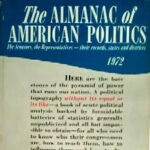
Language on the dust jacket from the original 1972 copy of The Almanac of American Politics, which was listed as a finalist for the 1973 National Book Awards:
“Here are the bare stones of the pyramid of power that runs our nation. A political topography without its equal or its like – a book of acute political analysis backed by formidable batteries of statistics generally unpublicized and all but impossible to obtain — for all who need to know who their congressmen are, how to reach them, how to influence them, and how to defeat or elect them.”
How is all the reporting for the Almanac done? And how has it changed over the years?
Jacobson
What’s changed the most is the technology we use, thankfully. When I first started writing for the Almanac in the late 1990s, it used to be we’d get all the research for a congressional district from a LexisNexis printout that would stack three or four inches tall. And for each member, our printouts would be quite a bit taller than that. We’d take these huge file folders of this stuff home at night to work on. These days, however, we all use Google Docs, so everything is edited remotely. And we can share our information with just a few clicks instead of having to carry it around.
But even what I was doing in the late 1990s with LexisNexis was quite advanced compared to what Barone and company were doing in 1972. When they wanted out-of-town newspapers, they had to order them in advance from a newsstand. Barone basically put in a standing order at a newsstand for a newspaper or two from every state for several months at a time. And then they’d use a razor to clip out articles for their files—and they’d somehow turn all of that into copy. And for their statistical data, they were having to rely on other volumes of history, things like Depression-era WPA studies of various states and other histories.
For the electoral data, it’s hard to imagine how they were able to get all of it. Barone talked about how they would use road atlases and crayons to draw all the district boundaries and stuff like that. I can’t even imagine how they pulled it off.
For those of us in state government, who might benefit most from the book?
Jacobson
You know, when I’m planning a vacation, I rely on travel guidebooks to learn about the places I’m visiting. I study up before I go. And I think the Almanac serves the same purpose as a travel guidebook: It gives you the lay of the land in Congress and in American politics. So I would say that anybody in a state position who deals with lobbying or interacting with the federal government, particularly Congress, would benefit most from the book.
It’s particularly useful if you’ve got to lobby a Congressional member who’s in a senior position on some obscure subcommittee because you can get to know something about them, where they came from, and what their legislative interests are, which can help you with your pitch on the issue you’re trying to convince them on.
At more than 2,000 pages, the Almanac is a large book, which can’t be cheap to print. Why produce a print version in this digital era?
Jacobson
We do offer a digital version of the book. It’s not a Kindle version, but it’s kind of like a Kindle version. And there is a small fraction of our purchases who are getting the digital version. But, you know, among political insiders, a lot of people obsessively collect the printed version of the Almanac. You’ll see on my own bookshelf: I have every Almanac going back to 1972. And there are others who might not have the book all the way back to 1972, but they’ve certainly got a long shelf full of them. So we have a large number of readers who just appreciate having the book on their desk—they like to have a hard copy. And while, conceivably, there could come a time when we don’t get enough purchasers to print a physical book anymore, thankfully, we’re not at that point.

Jacobson’s bookshelf houses a complete collection of all editions of the Almanac going back some 50 years.

Purchase the Almanac – and get a 15% CSG discount
CSG readers are eligible for a 15% discount when purchasing the 2026 edition of The Almanac of American Politics. Please visit The Almanac of American Politics website and use the code COSG26 when you create your account to receive the discount.