
Coming this fall, a new federal definition of hemp will take effect. But what it means for states, their own regulations and laws, and hemp growers remains unclear.

Sen. Mark Spreitzer
From his viewpoint in Wisconsin, Sen. Mark Spreitzer says the federal change makes legislative action more urgent in a state like his — where no laws specifically regulate the intoxicating hemp products currently legal to sell under the so-called “Farm Bill loophole.”
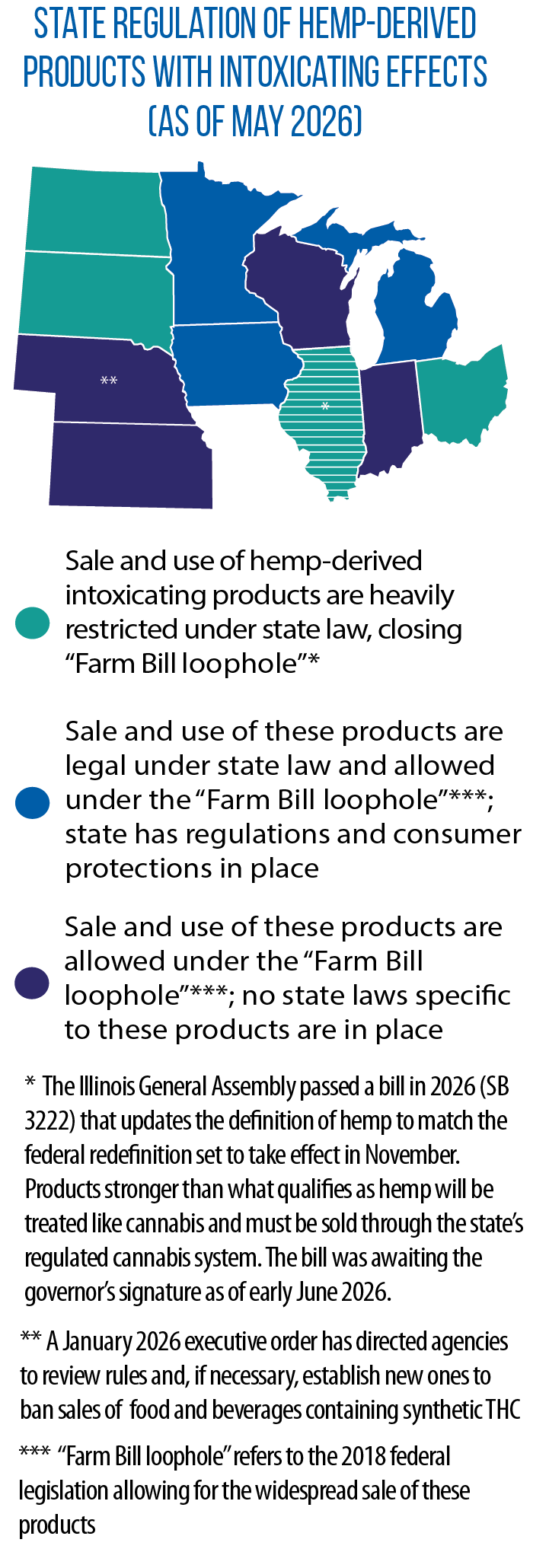
“It puts more pressure on states that haven’t enacted anything,” he says. Spreitzer represents one of the five Midwestern states that do not regulate hemp-derived products with intoxicating effects (see map).
On paper, at least, the new federal definition would seem to close the loophole, thus resolving some of the regulatory uncertainty over hemp and limiting some state policy options. This definition, part of a federal law enacted late last year and set to take effect on Nov. 12, classifies legal hemp as cannabis containing less than 0.3 percent total tetrahydrocannabinol (THC) on a dry weight basis. Hemp-derived cannabinoid products containing more than 0.4 milligrams of THC per container will not qualify as hemp and instead be treated as marijuana.
According to the U.S. Hemp Roundtable, an advocacy organization for the industry, the federal change means a majority of hemp-derived cannabinoid products will contain illegal concentrations of hemp and has the potential of eliminating 95 percent of the hemp industry. But recent experience points to another possibility: non-enforcement.
Enforcement uncertainty
Marijuana production, sales and use are illegal under federal law, but a longstanding practice of non-enforcement has been in place for more than a decade.
Could the same happen with hemp-derived cannabinoids?
Spreitzer and others believe that if a state has its own laws to regulate hemp-derived cannabinoids, there is a better chance the U.S. Department of Justice will treat the related products like medicinal and adult-use marijuana.
Though speculative, this nonenforcement scenario seems more likely after two federal actions: a December 2025 presidential executive order on the development of THC serving limits and the U.S. Department of Justice’s reclassification in April of state-licensed medical marijuana from a Schedule I controlled substance to a less-restricted Schedule III.
About the ‘loophole’
When the U.S. Congress enacted the 2018 Farm Bill, it did not anticipate that removing longstanding federal restrictions on cannabis cultivation would, within less than a decade, contribute to the emergence of a billion-dollar hemp-derived product market — one primarily comprised of intoxicating edible and drink sales.
From 1970 until 2018, all parts of a cannabis plant were considered marijuana and classified as a Schedule I controlled substance. Policy changed with the 2018 Farm Bill, which defined hemp as “the plant Cannabis sativa L. and any part of that plant with no more than 0.3 percent delta-9 THC on a dry weight basis.”
The intent was to give farmers access to an alternative crop and develop market applications for hemp fiber, foods and CBD products. For instance, hemp stalk can be used to make fibers for textiles, paper, rope and biodegradable plastics; seeds can be used to make flour and oils. The leaves, flowers and buds contain cannabinoids — such as THC, which has intoxicating effects, as well as CBN (cannabinol) and CBD (cannabidiol), which are nonintoxicating — that can be used in a variety of consumable and non-consumable products.
Using federally compliant hemp, manufacturers began extracting and converting cannabinoids — such as delta-8 THC and other psychoactive isomers — for inclusion in edibles and beverages. While these products remain federally compliant because they contain no more than 0.3 percent delta-9 THC by dry weight, they can produce intoxicating effects comparable to marijuana.
According to a 2025 report by BDSA, a cannabis market research firm, the value of the hemp-derived market is about $23.9 billion. Intoxicating hemp-derived product sales made up most of that total ($21 billion). In comparison, the 2024 value of U.S. hemp production (the segment intended for authorization in the Farm Bill) was $445 million, according to the U.S. Department of Agriculture.
Regulate or ban?
Consumer demand for hemp-derived THC products quickly outpaced policy and regulatory frameworks. However, some state legislatures have since responded with new laws, some more restrictive than others. Enacted measures in Michigan (HB 4517 in 2021), Minnesota (HF 4065 in 2022) and Iowa (SB 2605 in 2024) reflect a balance between embracing the market for hemp-derived products and providing consumer protections.
These states’ regulations separate the definition of consumable hemp products from industrial hemp. Their regulations for hemp-derived products include potency limits, sales restrictions, labeling standards and more (see table).
Most recently, members of the Illinois General Assembly passed SB 3222 in the final days of the 2026 regular session.
This legislation updates Illinois’ definition of hemp to match the federal redefinition set to take effect in November. Under SB 3222 (still awaiting the governor’s signature as of early June 2026), products with THC concentrations stronger than what qualifies as hemp will be treated like cannabis and must be sold through Illinois’ regulated cannabis system.
In past legislative sessions, lawmakers in Ohio (SB 56 of 2025) and North Dakota (SB 2096 of 2023) adopted a restrictive definition of hemp: it must contain less than 0.3 percent of total THC on a dry weight basis to be legal. Come November, the federal redefinition will match these states’ provisions.
A 2026 law in South Dakota revises the definitions of “hemp” and “industrial hemp product” to exclude certain cannabinoids, including delta-8 THC, delta-10 THC, THC-O-acetate, HHC and THCP. Additionally, this enacted measure (SB 39) limits hemp cultivation to licensed producers and streamlines requirements for production, processing and transportation, reinforcing the state’s role as a top industrial hemp processor.
This year, Indiana’s SB 250 and Kansas’ SB 292 would have added similar state-based guardrails for intoxicating hemp-derived product; neither measure advanced
|
Regulation of Hemp-Derived Products in
3 Midwestern States |
|||
|
|
Iowa
|
Michigan
|
Minnesota
|
|
Purchase age
|
21+
|
21+
|
21+
|
|
Labeling required?
(THC content and impairment warning) |
Yes
|
Yes
|
Yes
|
|
Independent lab testing?
|
No
|
Yes
|
Yes
|
|
Sales restricted to registered retailers?
|
Not specified
|
Yes (marijuana dispensaries only)
|
Yes
|
|
Child-appealing packaging prohibited?
|
No
|
Yes
|
Yes
|
|
Potency limit
|
4 mg THC per serving; 10 mg per container
|
For edibles: 10 mg per dose; 200 mg per container; for beverages: 10 mg per serving; 100 mg per container
|
5 mg THC per serving; 50 mg per package
|
No laws in some states
This biennium, more than 30 bills have been introduced across the Midwest (most in states lacking any regulation) to address some regulatory aspect of the hemp-derived product market.
In Wisconsin, AB 503 would define hemp based upon a 0.3 percent total THC concentration, thereby eliminating most of the state’s $700 million market. SB 681 would have categorized intoxicating hemp-derived products as alcohol. But Sen. Spreitzer explains that Wisconsin bans vertical integration in its alcohol industry: “You have to have separation between the manufacturer, the distributor and the retailer.”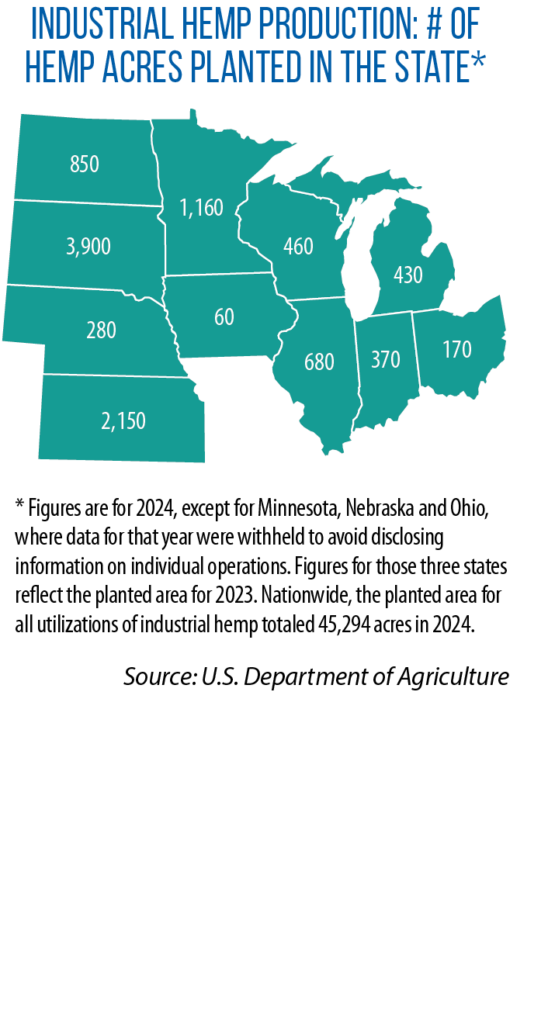 That would shutter current businesses, he says, noting that hemp manufacturing businesses rely heavily on online sales.
He instead offered support for SB 682, which would allow for the continued sale of intoxicating hemp products at gas stations, retail stores and online. The proposal includes regulations similar to those in place in other states:
- restrict sales of intoxicating hemp products to people 21 and older;
- limit THC content: 10 mg per serving for beverages and 20 mg for edibles;
- require independent testing; and
- ensure that the packaging is child-resistant, has warning labels, and does not have child-appealing features.
This year, Indiana’s SB 250 and Kansas’ SB 292 would have added similar state-based guardrails for intoxicating hemp-derived product; neither measure advanced.
The post ‘Farm Bill loophole’ has led to a booming industry for hemp-derived products and a mix of state laws; a new federal framework is coming soon appeared first on CSG Midwest.