On June 25, 1788, Virginia became the 10th state to ratify the U.S. Constitution.
Dubbed the “cradle of America,” Virginia has historically played a pivotal role in many of our nation’s most consequential moments. It was the site of the first permanent English settlement in America, Jamestown, established in 1607 on the banks of the James River. The Virginia House of Burgesses (known today as the Virginia General Assembly) first convened in 1619 and is our nation’s oldest representative legislative body.
Four of the first five U.S. presidents were born in Virginia, including George Washington, Thomas Jefferson and James Madison. And two of our fledgling nation’s most significant wars — the American Revolution and the American Civil War — both effectively came to a close on battlefields in Virginia.
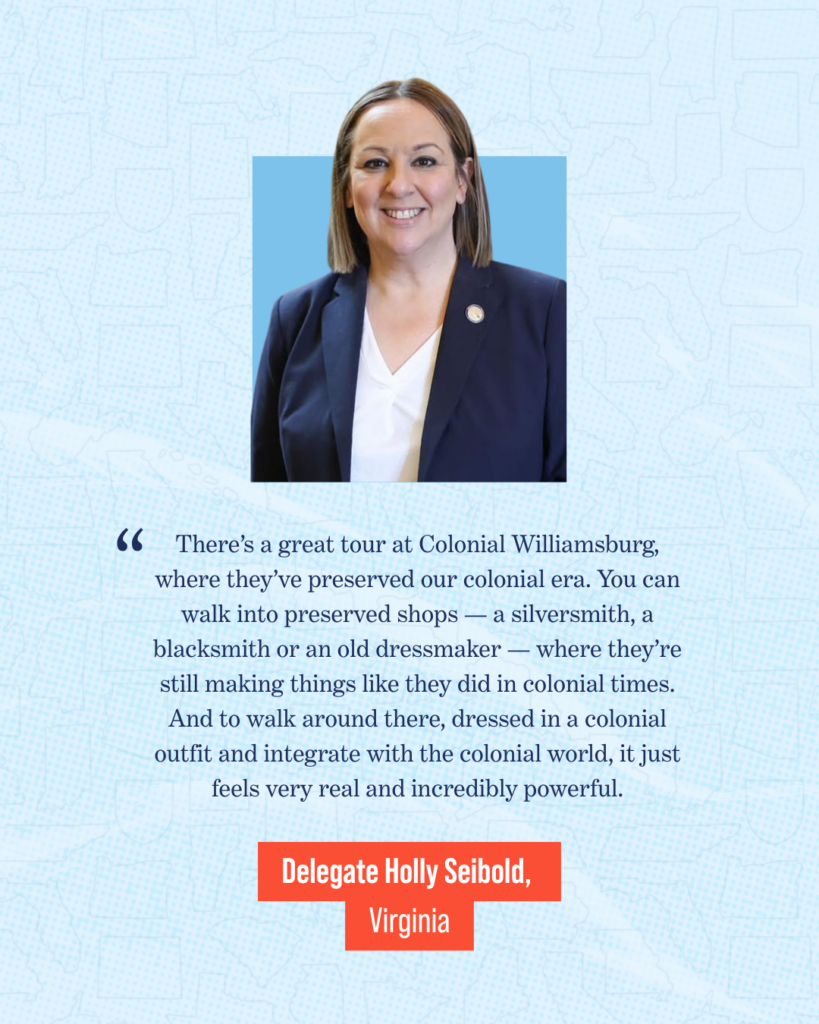
To visit Virginia and its many historical sites is to come remarkably close to stepping back into the nation’s founding era, said Virginia Delegate Holly Seibold, who represents the 12th District and is a 2024 graduate of the CSG South Center for the Advancement of Leadership Skills (CALS) program.

“There’s a great tour at Colonial Williamsburg, where they’ve preserved our colonial era,” Seibold said. “You can walk into preserved shops — a silversmith, a blacksmith or an old dressmaker — where they’re still making things like they did in colonial times. And to walk around there, dressed in a colonial outfit and integrate with the colonial world, it just feels very real and incredibly powerful.”
A former fourth-grade history teacher, Seibold said her students loved learning about Virginia’s history. Each year, they embarked on an ambitious field trip where they’d spend a day touring Jamestown, Colonial Williamsburg and the American Revolution Museum at Yorktown.
“That’s a lot of history in one day for just about anybody, let alone fourth graders,” Seibold added.
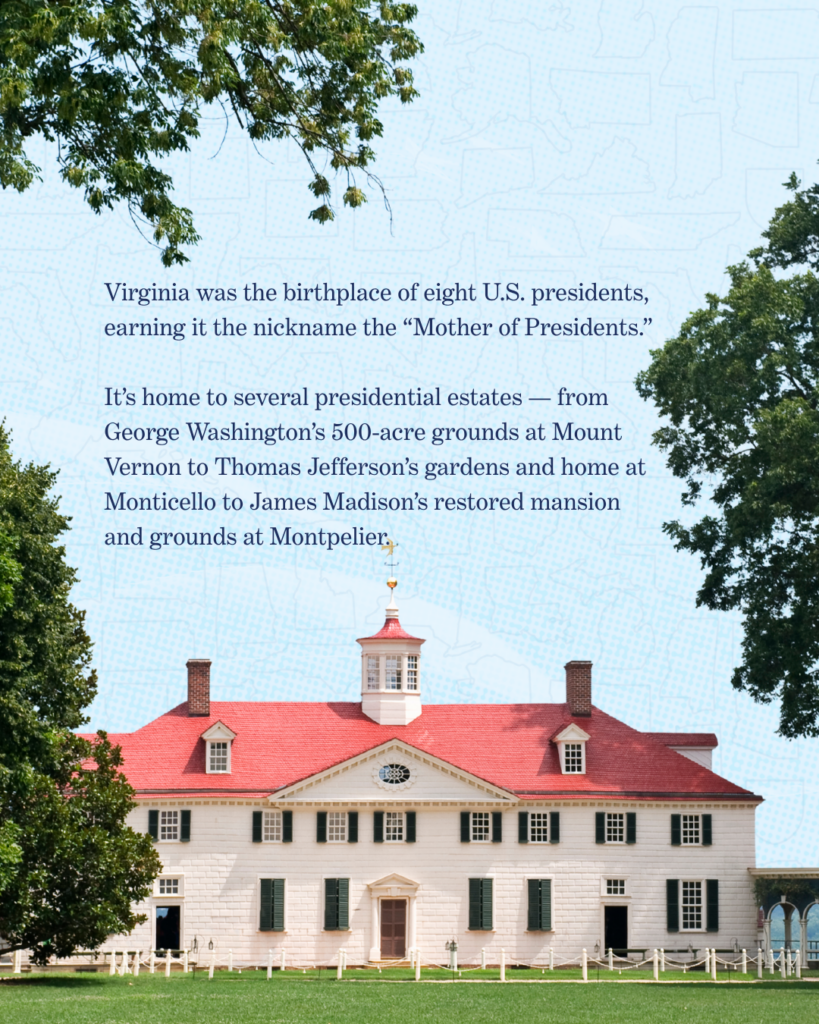
Virginia was the birthplace of eight U.S. presidents, earning it the nickname the “Mother of Presidents.” Consequently, it’s home to several presidential estates available for public tours — everything from George Washington’s 500-acre grounds at Mount Vernon to Thomas Jefferson’s gardens and home at Monticello to James Madison’s restored mansion and grounds at Montpelier.
“We tended to visit Mount Vernon the most because it’s closest to where we live,” Seibold said. “You can picnic there and tour the home and property — and it’s just gorgeous. George and Martha are both buried there as well. There’s just so much history to the place.”
While tourism understandably plays a central role in Virginia’s economy, more recently the commonwealth has become a technology and military powerhouse. To the north is Data Center Alley, just a short drive south of Washington, D.C., where a significant share of global internet traffic reportedly flows through hundreds of data centers that dot the region.
To the south lies Hampton Roads, a military and aerospace hotbed, home to Naval Station Norfolk, the world’s largest naval base, and the Virginia Air & Space Science Center, which features an assortment of NASA spacecraft, flight simulators and hands-on aerospace exhibits.
“We’ve really grown into an innovation and technology hub,” Seibold said. “And a lot of our military personnel who retire end up working as contractors for the Pentagon, the Department of War and the Department of Homeland Security. As a result, the area has Virginia’s highest population of veterans.”
On the food front, Virginia’s access to the Chesapeake Bay makes it famous for its crabs and oysters, which are hallmarks at various food festivals around the commonwealth. It’s also a leading producer of peanuts, renowned for its distinctively large and crunchy variety, often referred to as “ballpark peanuts.” More recently, Virginia has also cultivated a burgeoning wine industry, boasting more than 300 wineries and vineyards.
It is additionally home to more than 550 miles of the Appalachian Trail, which constitutes nearly one-fourth of the trail’s length, more mileage than any other state by more than 200 miles. On the southwestern edge of the trail is the Grayson Highlands State Park and Mount Rogers National Recreation Area, where trekkers can catch a glimpse of the more than 100 wild ponies that roam freely on the high-altitude meadows. And more wild horses can be found on Virginia’s northeastern rim at the Assateague Island National Seashore & Chincoteague National Wildlife Refuge, where they roam the island’s beaches and can be viewed via an eco-cruise around the coastal marshes.
“The horses have become an iconic symbol of the Virginia coast,” Seibold said. “And it’s a really cool, natural area right on the water that’s become a really popular place for people to visit and spend the day.”