On Nov. 21, 1789, North Carolina became the 12th state to ratify the U.S. Constitution.
North Carolina holds the distinction as the site of the first attempted English settlement in America, known to history as the Lost Colony. In 1587, a group of more than 100 colonists under John White settled on Roanoke Island. White soon set off to England for additional supplies, but when he returned three years later, the colony was gone and the fate of its inhabitants unknown (it’s speculated they assimilated into local Native American tribes or were killed).

In the approach to the American Revolution, North Carolina was “a hotbed of resistance” to Great Britain, said Rep. Stephen Ross, who represents the 63rd District and is a 2017 CSG Henry Toll Fellow. In 1771, a group of farmers known as “the Regulators” banded together to protest corruption, excessive fees and what they viewed as abuses by colonial officials. The Royal Governor sent a militia to crush the uprising at the Battle of Alamance.
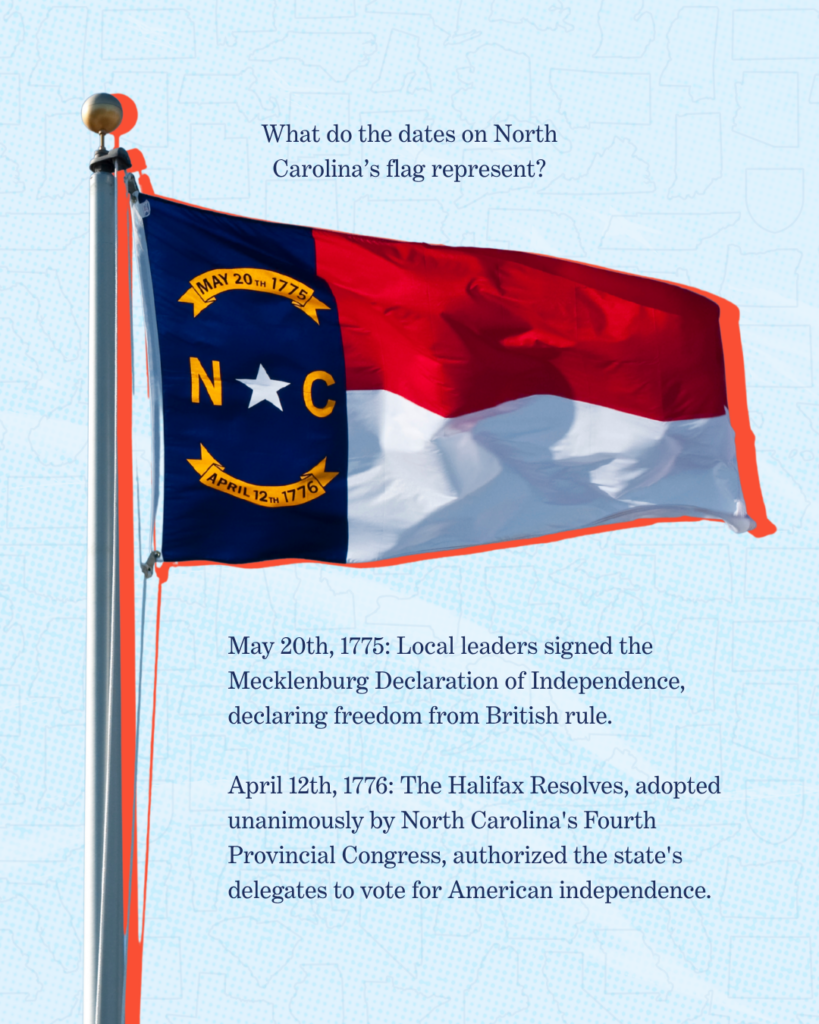
But the spirit of rebellion lived on. In 1775, a full year before the Declaration of Independence, residents of Mecklenburg County reportedly adopted what became known as the Mecklenburg Declaration of Independence — a document many regard as one of the earliest calls for separation from Great Britain. The following year, North Carolina became the first colony to officially authorize independence when its Provincial Congress adopted the Halifax Resolves.
During the war, North Carolina was the backdrop to numerous clashes with British forces, including the pivotal Battle of Guilford Courthouse in 1781. There, British General Lord Charles Cornwallis, though ultimately victorious, endured heavy casualties, estimated at more than a quarter of his army.
“Cornwallis really got hammered, and that forced his retreat to Yorktown, where the war eventually came to an end,” Ross said. “But it was all those skirmishes on the way through North Carolina that dramatically weakened his forces.”
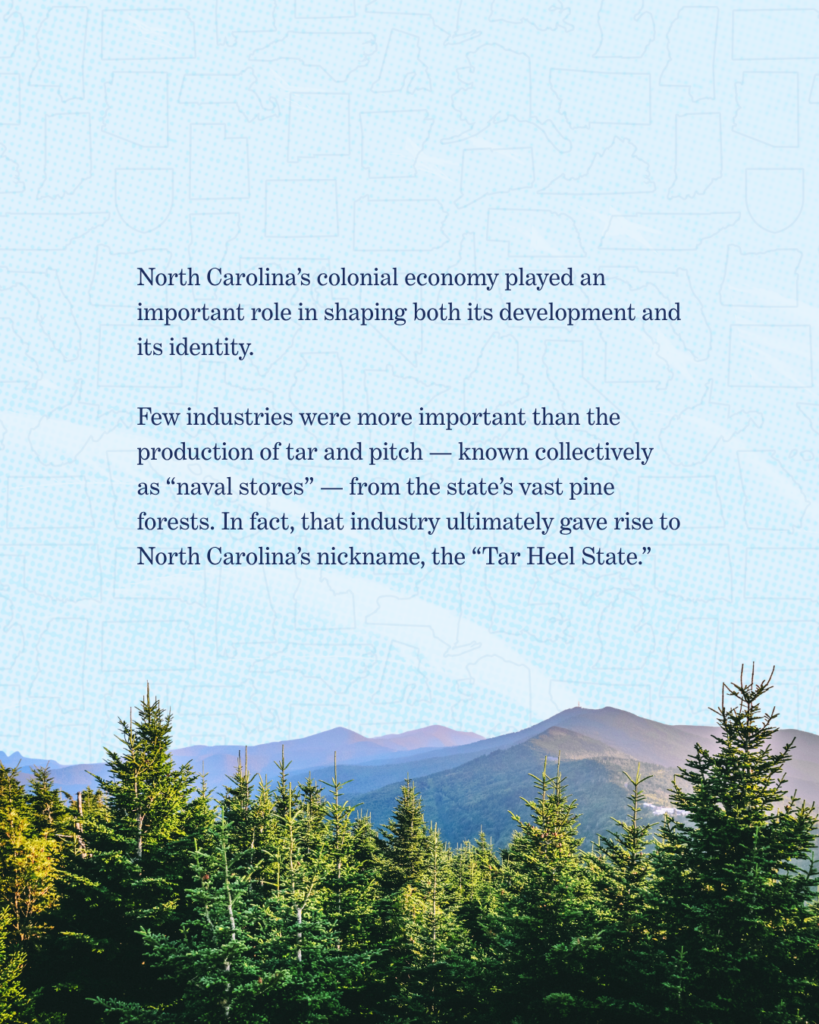
North Carolina’s colonial economy played an important role in shaping both its development and its identity. Few industries were more important than the production of tar and pitch — known collectively as “naval stores” — from the state’s vast pine forests. In fact, that industry ultimately gave rise to North Carolina’s nickname, the “Tar Heel State.”
In high demand by Great Britain for waterproofing its ships, the tar was stored in barrels and transported along wooden plank roads. Ross said the barrels often leaked, coating workers, equipment and anything else nearby with sticky tar.
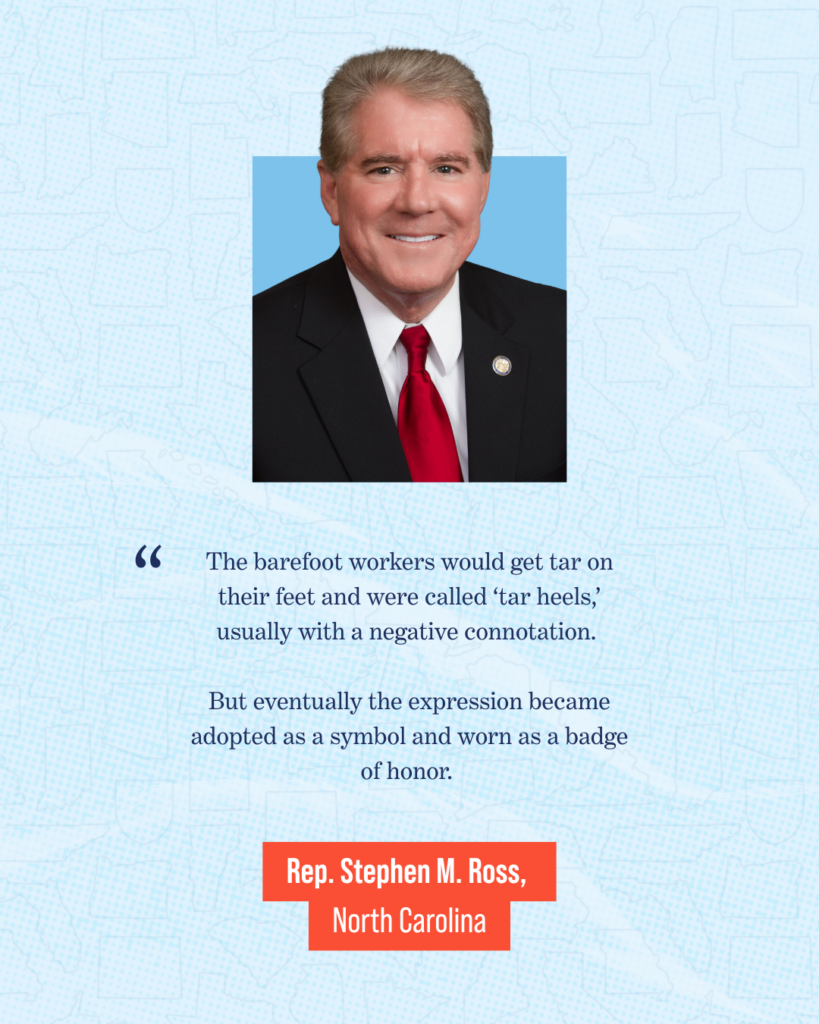
“The barefoot workers would get tar on their feet and were called ‘tar heels,’ usually with a negative connotation,” Ross said. “But eventually the expression became adopted as a symbol and worn as a badge of honor. And, of course, now even the University of North Carolina team is known as the Tar Heels, complete with a foot logo with a black blob of tar on the heel.”
North Carolina’s trees are in demand even in the modern era. With its abundant fir trees, the state is the nation’s second leading producers of Christmas trees. In fact, North Carolina has supplied the official White House Christmas tree on 16 occasions — more than any other state.
“My first year in college, I took a job over winter break cutting Christmas trees to make some extra money,” Ross said. “Let me tell you: that’s a hard day’s work. I’m not sure I’d want to do that as a career.”
North Carolina’s economy, historically, revolved around agriculture, notable for its nation-leading tobacco crop. It also was a hub for America’s textile manufacturing industry, producing materials and fabrics that complemented the state’s robust furniture manufacturing sector.
Those industries waned, owing largely to globalization. But North Carolina has since established itself as a major technology hub, thanks in part to the Research Triangle, as it’s known, where three of the state’s premier research universities — Duke University, the University of North Carolina at Chapel Hill and North Carolina State University — are located within close proximity.
“A lot of big names in pharmaceuticals and biotechnology have facilities in the area, and that’s been a huge employment draw,” Ross said. “And we’ve worked really hard as a state, through our community college system, to upscale our workforce and ensure people are trained to do those jobs.”
Those workforce investments, Ross added, have paid off. This decade, North Carolina earned the top spot in CNBC’s America’s Top States for Business rankings in 2022, 2023 and 2025, and placed second in 2021 and 2024.
“We consider that the crown jewel of recognitions, and it’s been a point of pride for our state,” Ross added.
Thanks to the state’s geographic diversity, featuring beaches along the Atlantic coast to the east and the Blue Ridge Mountains to the west, North Carolina draws millions of visitors each year. One of its more novel draws is the Biltmore Estate, located in Asheville, which is the nation’s largest privately built home. Built for George Washington Vanderbilt II in 1895, the Châteauesque mansion spans nearly 180,000 square feet and required a three-mile railroad spur be constructed to transport materials to the site.
“It’s amazing to walk through it,” Ross said. “The sheer size and quality of the construction — you can’t help but wonder how in the world did they do all this in the mountains?”