On May 29, 1790, Rhode Island became the 13th and final colony to ratify the U.S. Constitution.
Before independence, Rhode Island was an early center of resistance to British rule. In 1772, a group of Rhode Island townsmen burned a Royal Navy schooner, the HMS Gaspee, which was enforcing British customs trade laws in Narragansett Bay.
The colony also was the first to formally renounce allegiance to King George III, passing the Act of Renunciation on May 4, 1776 — two months before the Declaration of Independence.
When Rhode Island’s Legislature established an army in the wake of bloodshed at Lexington and Concord, it was placed under the command of Nathanael Greene, who led the brigade to Boston, where it joined ranks with the newly established Continental Army. Known for his strategic acumen, Greene became one of George Washington’s most trusted commanders and led the Southern campaign that helped bring the war to a close.
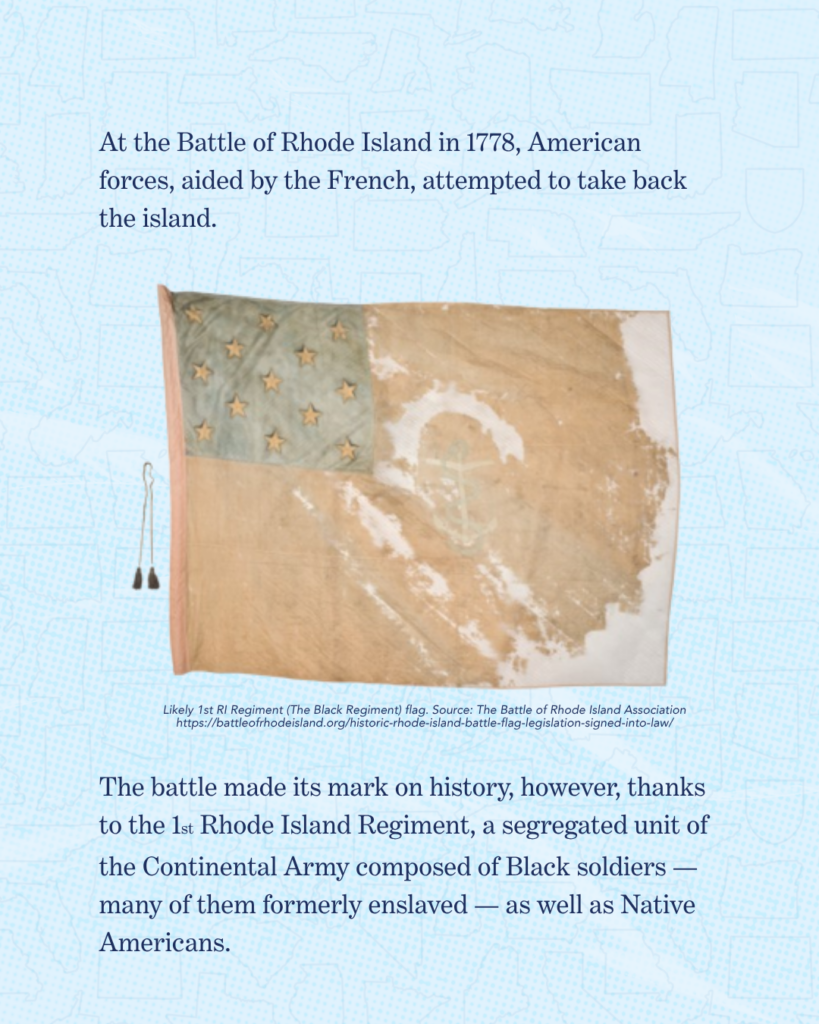
For much of the American Revolution, the British occupied Newport and its deep-water harbor. At the Battle of Rhode Island in 1778, American forces, aided by the French, attempted to take back the island. But fierce storms battered French and British fleets, and Great Britain maintained its grip. The battle made its mark on history, however, thanks to the 1st Rhode Island Regiment, a segregated unit of the Continental Army composed of Black soldiers — many of them formerly enslaved — as well as Native Americans. The “Black Regiment,” as it came to be known, proved its mettle, successfully fending off several Hessian attacks, and it continued to serve with high regard until the end of the war.

“Rhode Islanders are known for our independent streak,” said Rhode Island Rep. Michael Chippendale, the House minority leader and a 2024 CSG Henry Toll Fellow. “And we take a lot of pride with our early involvement of integrated troops and the important role they played in the founding of our nation.”
Chippendale said one of his favorite Rhode Island military stories stems from the Civil War, involving a bronze 12-pound cannon, known as the “Gettysburg Gun.” Manned by Rhode Island soldiers at the Battle of Gettysburg in Pennsylvania, the cannon played an instrumental role in prompting the ill-fated Pickett’s Charge, which led to thousands of Confederate casualties. After the cannon was damaged by shells and removed from the front lines, Confederate officers mistook it as a sign that the Union line was pulling back and the battlefield was ripe for a frontal assault.
“That one beautiful cannon, which can still be seen today in Rhode Island [on display at Varnum Memorial Armory in East Greenwich], helped turn the tide of the Civil War,” Chippendale said. “Because from that point on, the Confederacy was essentially in retreat.”
Its military history aside, Rhode Island has long been notable for its small size — the smallest of all the states. Just 37 miles wide and 48 miles long, the state somehow, in a geographic quirk, boasts nearly 400 miles of coastline.
“That fact will typically draw perplexing looks from people who might not be cartographers or all that familiar with Rhode Island’s shape,” Chippendale said, adding that the reason for so much coastline owes to the state’s many bays, inlets and islands.
All that access to the Atlantic Ocean not only furnished the state’s nickname, the Ocean State, but also has helped make Rhode Island a premier tourism destination for great beaches, sailing and remarkable seafood, Chippendale said.
“I’ve been blessed to have eaten all over the world, and there are few places that come close to Rhode Island,” Chippendale said. “I attribute a lot of that, initially, to our early Italian settlers who brought with them their food culture that’s become a staple here.”
More recently, Rhode Island’s cultural landscape has expanded to include Portuguese, French Canadian, Latino, Southeast Asian, West African and Caribbean communities, further shaping its culinary identity.
“You really see it reflected in our food and our festivals, which has only made Rhode Island’s culinary scene that much better,” Chippendale said. “You really never run out of places to go here where you can find truly world-class restaurants.”
Rhode Island, in fact, boasts the oldest continuously operating restaurant in the nation, the White Horse Tavern, located in Newport, which first opened in 1673.
“With its post and beam construction and floors with the wide planking, it still looks the way it was built in the 1700s,” Chippendale said. “And the history of the place is incredible. After the British took control of Newport, it’s where British leadership could be found planning and plotting to destroy the colonies. You certainly get a patriotic feeling just going there.”