On July 26, 1788, New York became the 11th colony to ratify the U.S. Constitution.
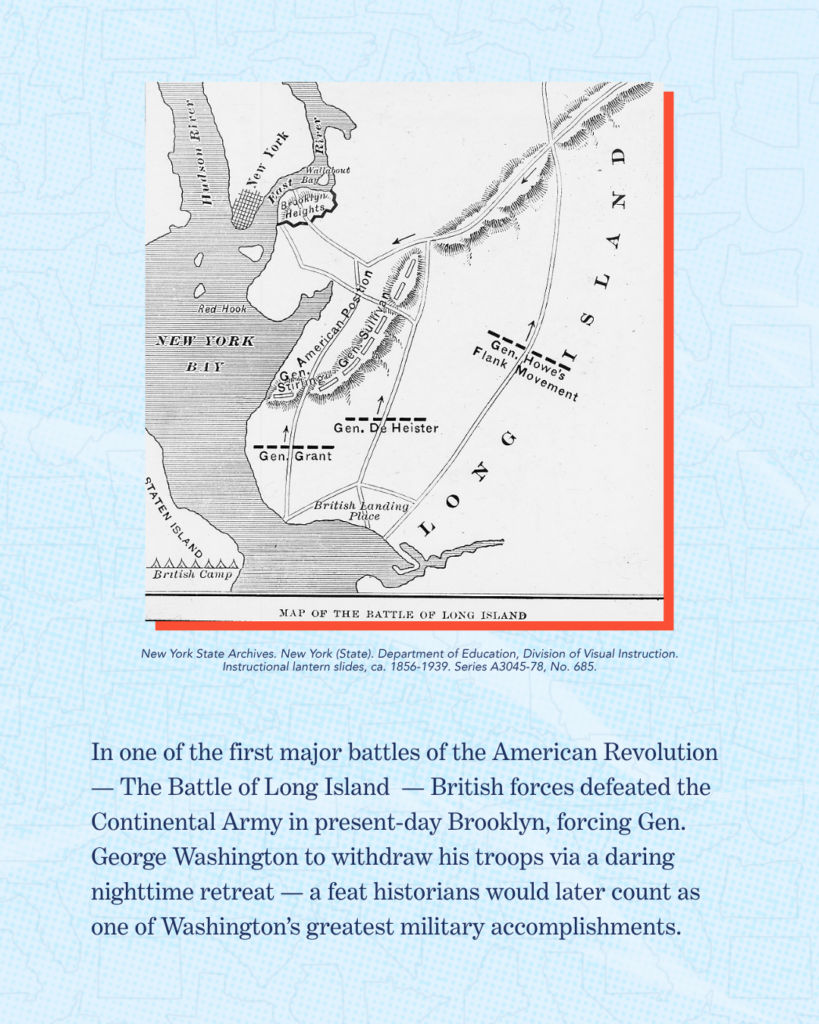
With its port and central location among the other colonies, New York played a pivotal role during the American Revolution. In one of the war’s first major battles, British forces defeated the Continental Army in present-day Brooklyn, forcing Gen. George Washington to withdraw his troops via a daring nighttime retreat — a feat historians would later count as one of Washington’s greatest military accomplishments.
The loss at the Battle of Long Island left the city’s port and harbor in British control, giving them a strategic outpost that served as the British Army’s North American base of operations for the remainder of the war.
Before the war, New York’s population was largely mixed, divided between Loyalists, Patriots and those who sought to remain neutral. But New York City had an active Sons of Liberty faction that would frequently erect “liberty poles” — tall wooden masts often capped with a “liberty cap” or flag that signified defiance against British rule.
The poles proved a nuisance to British troops stationed there, and they would cut down the poles shortly after their appearance. As this pattern continued, tensions escalated, leading to one of the earliest pre-war skirmishes, known as the Battle of Golden Hill, in which several soldiers and townsfolk were wounded in early 1770.

“It’s an interesting bit of history that often goes forgotten, even though it predated the Boston Massacre by several weeks,” said New York Assemblyman Michael Benedetto, who represents the 82nd District and served as CSG East Co-Chair in 2018.
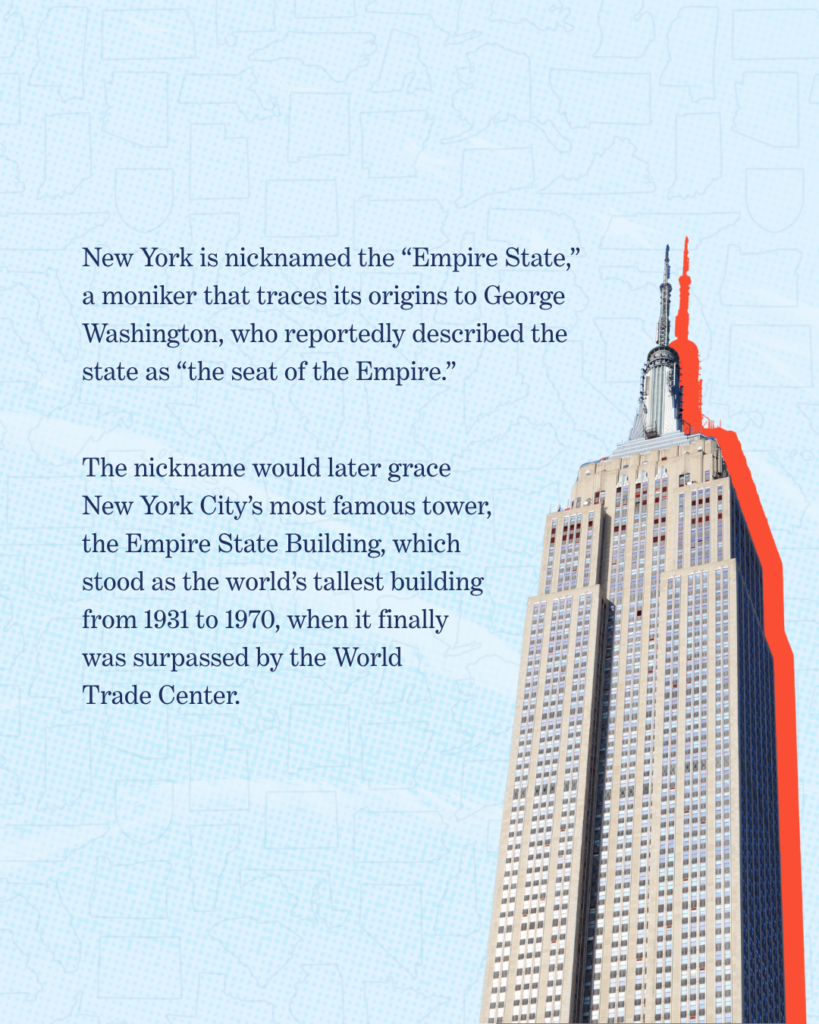
New York is nicknamed the “Empire State,” a moniker that traces its origins to George Washington, who reportedly described the state as “the seat of the Empire.” The nickname would later grace New York City’s most famous tower, the Empire State Building, which stood as the world’s tallest building from 1931 to 1970, when it finally was surpassed by the World Trade Center.
Another of New York’s most iconic structures — the Statue of Liberty — was a gift from France, commemorating the 100-year anniversary of the United States’ independence. Depicting the Roman goddess of liberty, the statue stands some 305 feet tall and greets those arriving via the New York Harbor to Ellis Island, once the nation’s busiest immigration processing station.
“The Statue of Liberty is very much a symbol of New York,” Benedetto said. “And it’s a fitting tribute to one of the most diverse cities in the world.”
A native of the Bronx, Benedetto recalled his early years playing baseball with neighborhood kids at the schoolyard across the street from his home, where his mom could keep an eye on him from the kitchen window. During the summer months, his family would make regular Sunday pilgrimages to Central Park, where they would picnic and stand in line for free tickets to the Shakespeare in the Park stage productions.
“I remember one summer we got tickets to see ‘Two Gentlemen of Verona,’ which later came to Broadway and went on to win the Tony Award for Best Musical,” Benedetto said. “It was a wonderful performance, and such a delight for us kids. And it underscores just how important Central Park is to New York City, as well as the foresight that went into the urban planning and putting such a wonderful green space into a large, surrounding metropolis.”
North of New York City is what’s referred to as upstate New York, and some visitors might be surprised to learn the state has one of the nation’s largest agricultural sectors, with milk and other dairy products accounting for nearly half its sales. New York is also the nation’s second-largest apple grower, behind only Washington state.
Through the latter half of the 20th century, upstate New York was also a technology powerhouse, analogous to an early version of Silicon Valley, all located in the city of Rochester. Three companies in particular — Kodak, Xerox and Bausch & Lomb — spearheaded great technological leaps in a variety of consumer products, such as film cameras, copiers, and eyeglasses and contact lenses. The arrival of the digital age, however, swiftly brought that era’s heyday to a close.
“It was an amazing period of technological discovery,” Benedetto said. “And I think it’s equally amazing that we’re probably the first generation that can both witness the rise of great inventions that change the world by leaps and bounds and in that same lifespan see these technologies become obsolete.”
Another facet of New York life that looms large is its sports history. With professional teams such as the Brooklyn Dodgers, the Yankees and Mets, the Knicks and Nets, the Giants and Jets, the Rangers and Islanders, and the Buffalo Bills and Sabres; New York is home to some of America’s most storied professional sports franchises, teams that won more than 50 championships during the 20th century alone.
“New York has a sports heritage that’s hard to put into words,” Benedetto said. “Babe Ruth. Joe Namath. Mickey Mantle. Jeter and Judge. And all that before we even get to the great teams that Buffalo has had over the years. I remember as a kid going to the old Polo Grounds (the former home of the New York Giants), and it was an experience I’ll never forget.”