On Jan. 2, 1788, Georgia became the fourth American colony to ratify the U.S. Constitution.
Initially, Georgia was slow to join the revolutionary cause, with the region divided between Loyalists and Patriots. But as news of the Declaration of Independence spread and tensions heightened, driven in part by the British capture of Savannah in 1778, Georgians began rallying behind the fight for independence. The state witnessed its share of crucial battles, including the failed Siege of Savannah and, later, the Siege of Augusta, in which American forces, led by Andrew Pickens and Henry Lee, forced the British surrender at Fort Cornwallis, thanks to a hastily constructed 30-foot wooden tower that offered their lone cannon a vantage point for breaching the fort’s walls. The tide of the war in the South turned with the arrival of General Nathanael Greene in 1781, who helped regain control of Savannah, ultimately leading to British withdrawal in 1782.
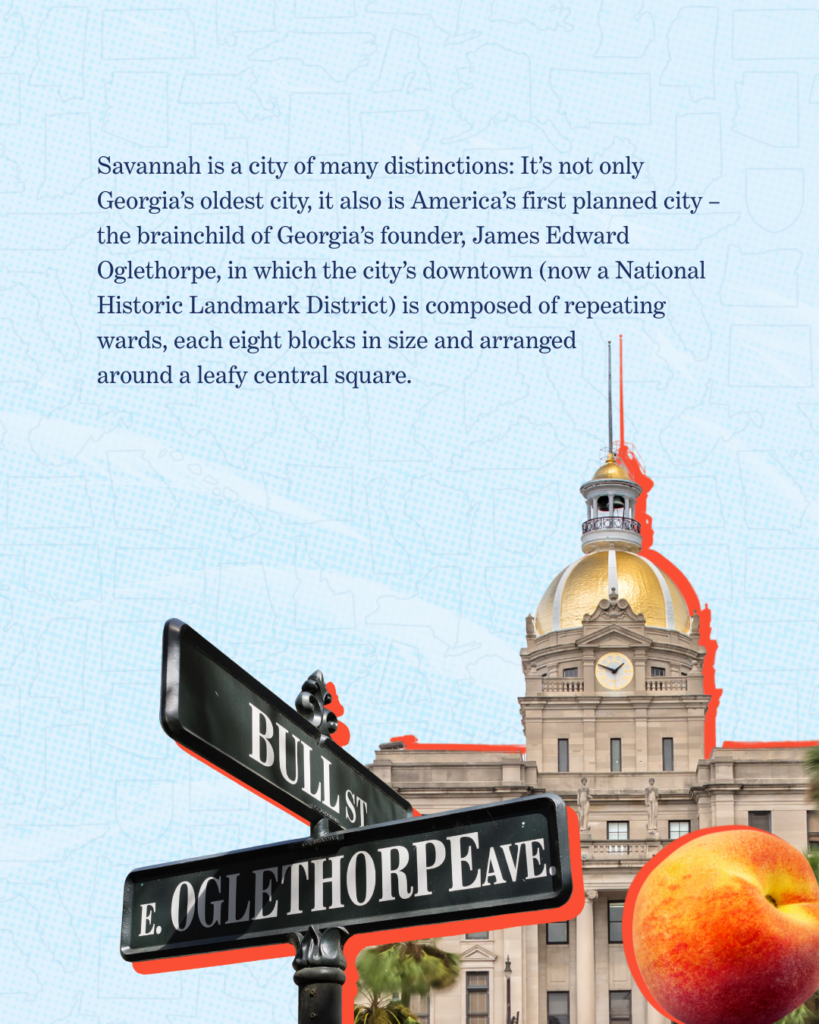
Savannah is a city of many distinctions: It’s not only Georgia’s oldest city, it also is America’s first planned city — the brainchild of Georgia’s founder, James Edward Oglethorpe, in which the city’s downtown (now a National Historic Landmark District) is composed of repeating wards, each eight blocks in size and arranged around a leafy central square. The city also is home to one of the nation’s oldest Jewish congregations, founded by a group of Jewish immigrants, who arrived from London in the 1730s after being turned away at other coastal ports. Among those on the ship was Dr. Samuel Nunes, a Jewish physician credited with saving the lives of scores of colonists suffering from yellow fever.
“It’s a great story about the welcoming arms of Georgia,” said Georgia Rep. Beth Camp, an eighth-generation Georgian and a 2024 CSG Henry Toll Fellow. “Our state is a melting pot for a lot of different reasons, and I’m really proud that people here tend to be raised with a mentality for helping others.”
Georgia’s welcoming spirit, Camp said, is reflected in many of the state’s city names.
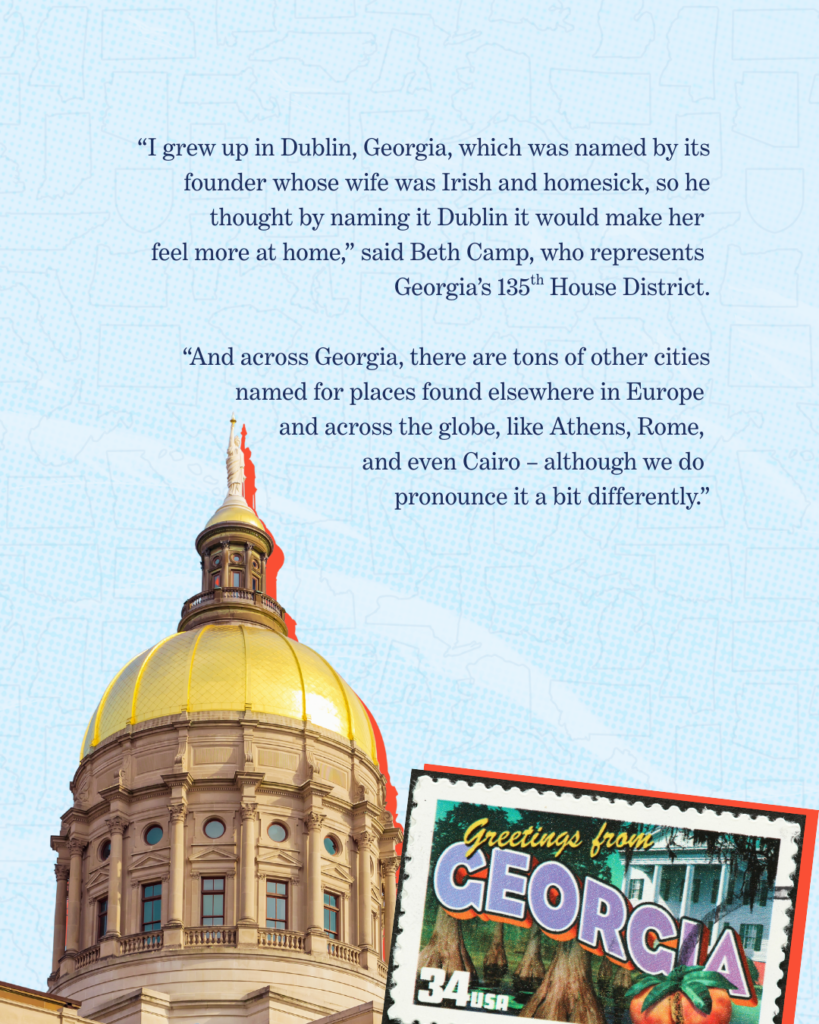
“I grew up in Dublin, Georgia, which was named by its founder whose wife was Irish and homesick. He thought by naming it Dublin it would make her feel more at home,” Camp said. “And across Georgia, there are tons of other cities named for places found elsewhere in Europe and across the globe, like Athens, Rome, and even Cairo – although we do pronounce it a bit differently.”

Georgia has made its mark on popular culture, playing an outsized role in everything from music to film, television to food. The state has produced chart-topping artists in just about every musical genre, including the Allman Brothers, REM, James Brown, Ray Charles, Trisha Yearwood, the B-52s, the Black Crowes, Outkast and Indigo Girls. Likewise, with its agreeable seasonal weather, Georgia is a popular shooting location with film and television producers. Several of the Marvel movies, the television series The Walking Dead, and The Hunger Games were filmed in the state.
“I live not far from two filming locations, and it’s kind of weird telling people that I’m basically from a post-apocalyptic area,” Camp said with a laugh.
The state also is home to Coca-Cola (the popular soft drink was invented in Atlanta) as well as the restaurants Chick-fil-A and Waffle House, both of which are among America’s most highly rated eateries in customer satisfaction surveys.
“The food is just wonderful here,” Camp said. “We’re very seasonal and very farm-to-table, and that likely owes to the blessing of having an extended growing season, which allows us to do some amazing things.”
Georgia also holds an interesting geological feature: the lower portion of the state (called the Coastal Plain) was, in prehistoric times, beneath the Atlantic Ocean. As a result, the region’s soil is noticeably sandier than its clay-based counterpart found in the state’s northern reaches, making it ideal for growing all kinds of agricultural produce, from peanuts to peaches. But that ideal growing soil comes with a catch: it’s likewise ideal for insects, which is why the ecological line dividing the northern and southern parts of the state, known as the Fall Line, is often referred to by locals as the “Gnat Line.”
“It’s true, I’ve swallowed a great deal of gnats over the years,” Camp said. “I believe that’s why I’m taller than both my parents — I had a protein source, and they were smart enough to close their mouths when they’re outside. To be fair, the gnats are harmless. They’re more a nuisance because they like to fly around your nose and mouth. My husband hadn’t really been exposed to gnats until he went to college in Tifton. And to this day he tells me he doesn’t think he can be buried in our family cemetery because of the gnats. I tried telling him he’ll be below ground, where there won’t be any gnats. And he replied, ‘I just don’t want to take the chance.’”