On April 28, 1788, Maryland became the seventh American colony to ratify the U.S. Constitution.
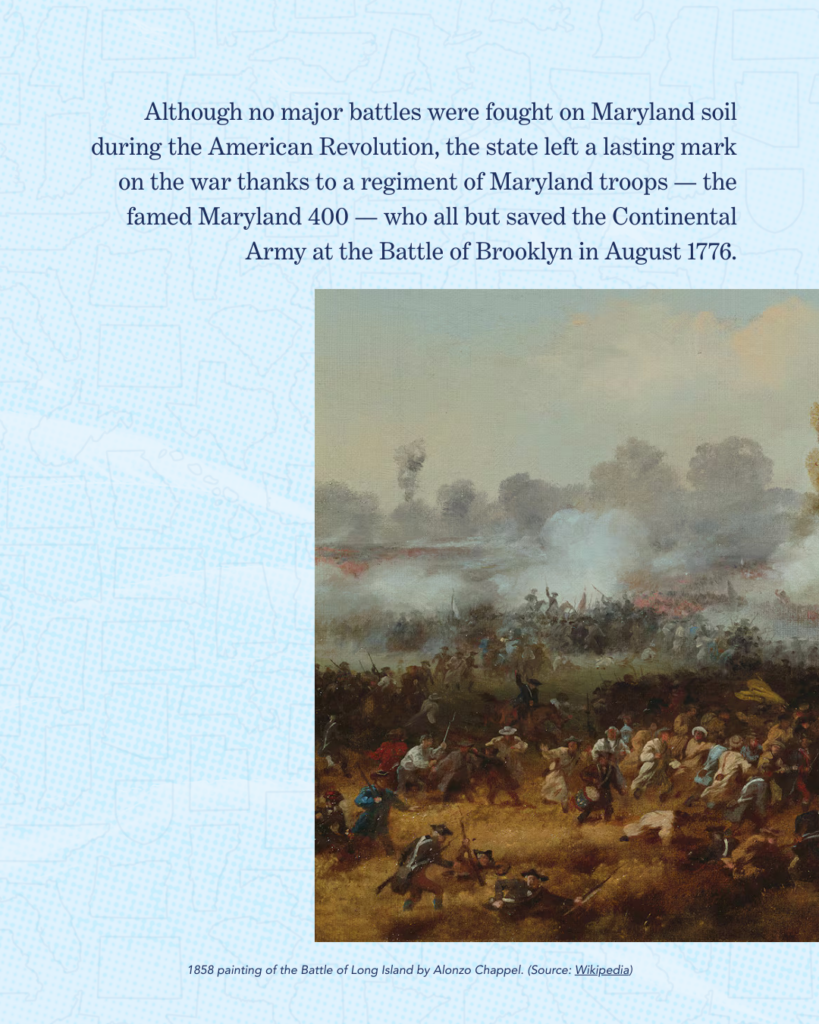
Although no major battles were fought on Maryland soil during the American Revolution, the state left a lasting mark on the war thanks to a regiment of Maryland troops — the famed Maryland 400 — who all but saved the Continental Army at the Battle of Brooklyn in August 1776.
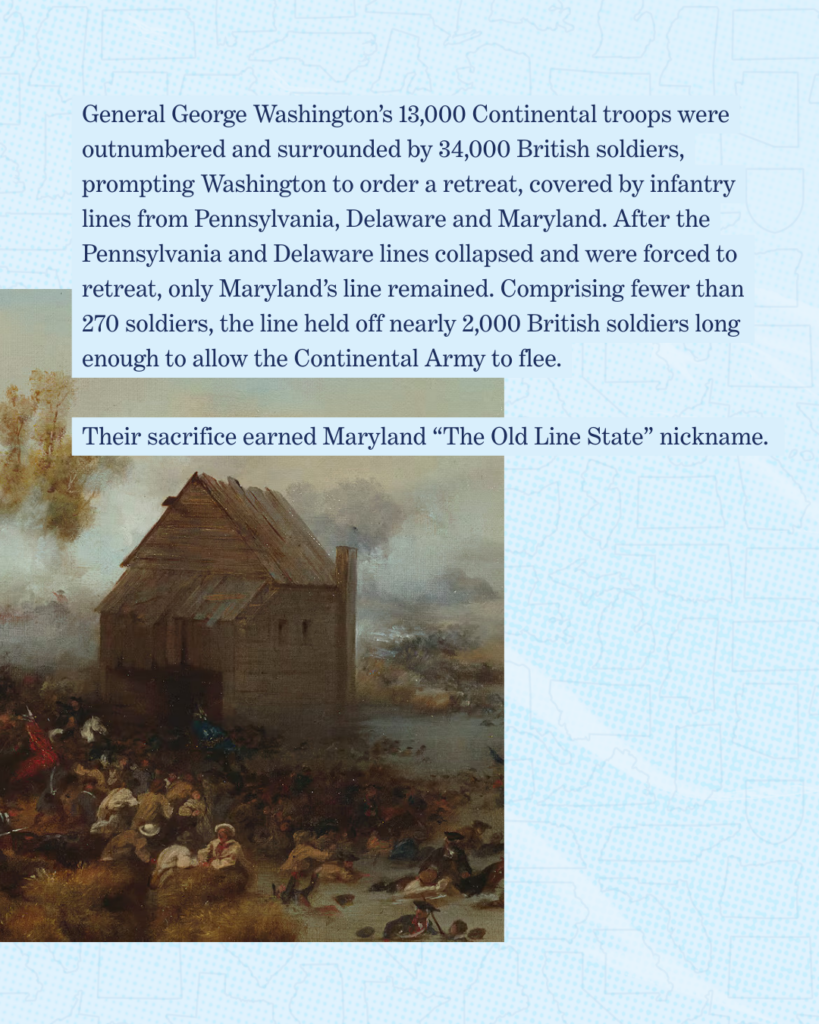
General George Washington’s 13,000 Continental troops were outnumbered and surrounded by 34,000 British soldiers, prompting Washington to order a retreat, covered by infantry lines from Pennsylvania, Delaware and Maryland. After the Pennsylvania and Delaware lines collapsed and were forced to retreat, only Maryland’s line remained. Comprising fewer than 270 soldiers, the line held off nearly 2,000 British soldiers long enough to allow the Continental Army to flee.
In the end, 256 Marylanders were killed, wounded or captured, a tragic outcome prompting Washington to reportedly remark: “Good God, what brave fellows I must this day lose.” Their sacrifice earned Maryland “The Old Line State” nickname. To this day, a monument commemorating the Maryland Line’s bravery still stands in Prospect Park, Brooklyn.
“If it hadn’t been for the Maryland regiment doing their part and holding that line, the war could have been lost right there, and our nation might not have been founded,” said Maryland Sen. Shaneka Henson, who represents District 30. “So that moniker as The Old Line State is something that Marylanders hold very proudly, and the line’s fighting spirit has become a part of Maryland’s culture.”

Any conversation about Maryland as a state wouldn’t be complete without mention of the Chesapeake Bay, the largest estuary — a mix of fresh and salt waters — in the U.S., which is “such an important part of who we are and the telling of our history,” Henson said.
“I think every Marylander’s relationship to the Chesapeake Bay is different,” Henson said. “For me, growing up as a kid, we would always go to Sandy Point State Park. So the Bay for me was a place for beaches and recreation. My dad, however, loves to boat. And we grew up in Annapolis, which prides itself on being the ‘Sailing Capital of the World.’ And we couldn’t be that if it weren’t for the Chesapeake Bay.”
The Chesapeake’s unique waters create an ideal environment for crabs, particularly the Maryland Blue Crab, renowned for its sweet, delicate flavor. Producing about half the blue crabs in the U.S., Maryland is celebrated for its culinary crab traditions, which usually involve steaming the crustaceans and flavoring them with one of two heavy seasonings: Old Bay or J.O.
“Old Bay and J.O. are essential components,” Henson said with a laugh. “And the few people I know who are allergic to shellfish, well, I cry for them because crabs are such a part of Maryland’s identity. We get real snobby about how we like our crab and our crab cakes.”
Maryland is also home to the U.S. Naval Academy in downtown Annapolis, located just a few blocks from the Maryland State House (one of the oldest capitol buildings in the U.S.). First-year students, known as plebes, are largely bound to the academy’s grounds, owing to tradition. Once they’ve gotten through that first year, they’re then called midshipmen, which comes with a uniform and rank change as well.
“It’s a really big deal to get through your first year at the academy,” Henson said. “So we don’t see a lot of the first-year cadets because they’re so busy and don’t have a lot of liberties yet. But once they get through that first year and become mids, we see them all the time. And we often will bring them in for our District Night, when all of Maryland’s 47 legislative districts bring in constituents from their area to celebrate what makes them unique.”
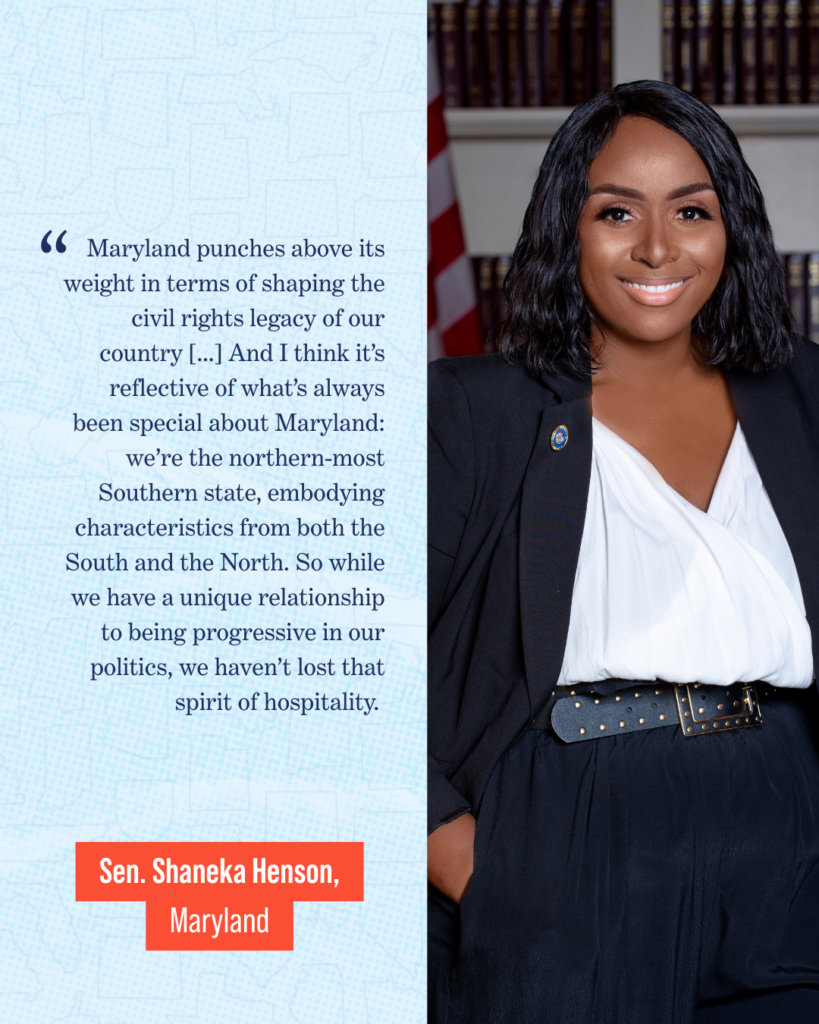
Lastly, Maryland has a legacy of leaders in the emancipation and civil rights movements, including abolitionists Harriet Tubman and Frederick Douglass, as well as famed civil rights attorney and U.S. Supreme Court Justice Thurgood Marshall. “Maryland punches above its weight in terms of shaping the civil rights legacy of our country,” said Henson, who is the first Black senator elected in her district. “We also have the largest legislative Black caucus in the country, and we’ve elected more Black people to the general assembly than any other state. And I think it’s reflective of what’s always been special about Maryland: we’re the northern-most Southern state, embodying characteristics from both the South and the North. So while we have a unique relationship to being progressive in our politics, we haven’t lost that spirit of hospitality.”