On March 4, 1791, Vermont became the first state admitted to the Union after the original 13 colonies.
Prior to joining the United States, Vermont operated as an independent nation, minting its own currency, running a postal service and forming its own military, the Green Mountain Boys. During the American Revolution, a contingent of Green Mountain Boys, led by Ethan Allen, crossed Lake Champlain and captured Fort Ticonderoga in a night raid. It was a gambit that would prove crucial later in the war. The cannons and other artillery seized from the fort were transported 300 miles through heavy snow to Boston, where they helped George Washington drive the British army from the city.
Known as the Green Mountain State for its verdant, rolling mountains, Vermont is mostly rural in nature, composed primarily of small towns of 2,500 people or fewer. Its largest city, Burlington, has a population of fewer than 50,000. Its statehouse, though regarded as one of the best-preserved Capitol buildings in the country, is the smallest of its kind. And even Vermont’s capital city of Montpelier is on the small side, with fewer than 10,000 residents.
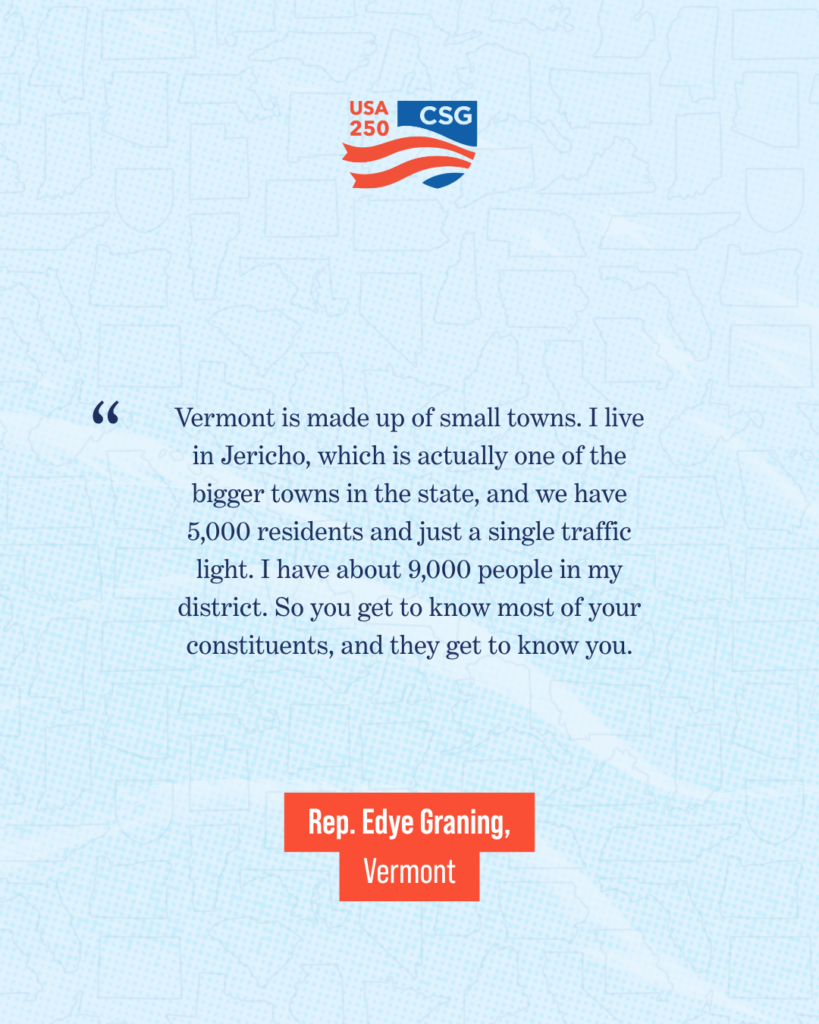
“One of the fun facts about Montpelier is that it’s the only state capital that doesn’t have a McDonald’s,” said Vermont Rep. Edye Graning, who represents the 20th District and is a 2025 CSG Toll Fellow. “And it’s true, Vermont is made up of small towns. I live in Jericho, which is actually one of the bigger towns in the state, and we have 5,000 residents and just a single traffic light. I have about 9,000 people in my district. So you get to know most of your constituents, and they get to know you.”

One result of living in a rural state is that many communities don’t have enough residents to justify a local water treatment plant. As a result, most communities in Vermont rely on private water wells and septic systems.
“Our largest cities, like Burlington and Rutland, have water treatment, but the rest of us are on our own,” Graning said. “I have a well for my home. And my little neighborhood of 15 houses shares a community septic. But that’s part of life as a Vermonter: We value the land, and we’re accustomed to living off it.”
Vermont is among the nation’s top dairy producers, a cornerstone of its economy, and was once rumored to have more dairy cows than people. But Graning said that’s probably no longer true, as recent counts put the number of dairy cows at around 125,000 (with a human population at about four times that).
One of the state’s biggest dairy buyers is none other than Ben & Jerry’s, which began as a makeshift ice cream parlor run out of a renovated gas station in downtown Burlington and has since grown into a global giant, producing such memorable flavors as “Cherry Garcia,” “Phish Food” and “Chunky Monkey.”
“Ben & Jerry’s still makes roughly half of its ice cream in Vermont, and it’s sent all over the world,” Graning said. “And their factory tour is still Vermont’s largest tourist attraction, bringing in around 350,000 visitors each year.”
Another of Vermont’s signature sweets is maple syrup. The state tree is the sugar maple, and with good reason: Vermont produces more maple syrup than any other state. The production of maple syrup, however, is decidedly labor intensive. It takes 40-80 gallons of sap, on average, to produce a single gallon of maple syrup.
“It is a lot of work,” Graning said. “But we’re sure grateful to the people who figured out how to make it happen. If you’ve never been to a sugar house when it’s boiling, you need to do that. You get a facial steam of maple syrup, and it just engulfs you. Your clothes end up smelling like maple syrup. It’s one of the most amazing things ever.”
In March, communities across Vermont celebrate with a maple syrup festival, offering participants “sugar on snow” (which translates to maple syrup on shaved ice) and another sweet treat called a “creemee,” which is a soft-serve ice cream cone, usually combined with some maple syrup flavors.
“Vermonters love their creemees,” Graning added. “Some of us have been known to drive quite far to get a good maple creemee, myself included. So yeah, we love our maple syrup here, and we take it very seriously.”
Despite the prominence food plays in Vermont’s economy, tourism is still the state’s biggest economic driver. The state is home to more than 25 alpine skiing resorts, including Killington, Sugarbush, Stowe and Stratton. It also boasts more than 11,000 miles of hiking and biking trails as well as a wealth of water sports, such as kayaking and paddleboarding in the warm months and snowmobiling and ice fishing in the colder ones. Vermont also has made a name for itself in the disc golf world and features two courses at its Smugglers’ Notch Resort — Brewster Ride and Fox Run Meadows — that consistently rank among the best in the world.
But ask locals about their favorite recreational pastime, and many will talk about their love for the off-the-beaten-path swimming hole.
“Our rivers are generally not very deep, but they often have these hidden spots — the locals know where they are — where there are waterfalls and different heights from where you can jump from,” Graning said. “They’re all hidden gems. And I think there’s actually a website that helps you find them, wherever you are in the state. But I should warn you, a lot of Vermonters won’t tell you where their favorite swimming hole is because they don’t want them to get too popular.”