On Feb. 6, 1788, Massachusetts became the sixth American colony to ratify the U.S. Constitution.
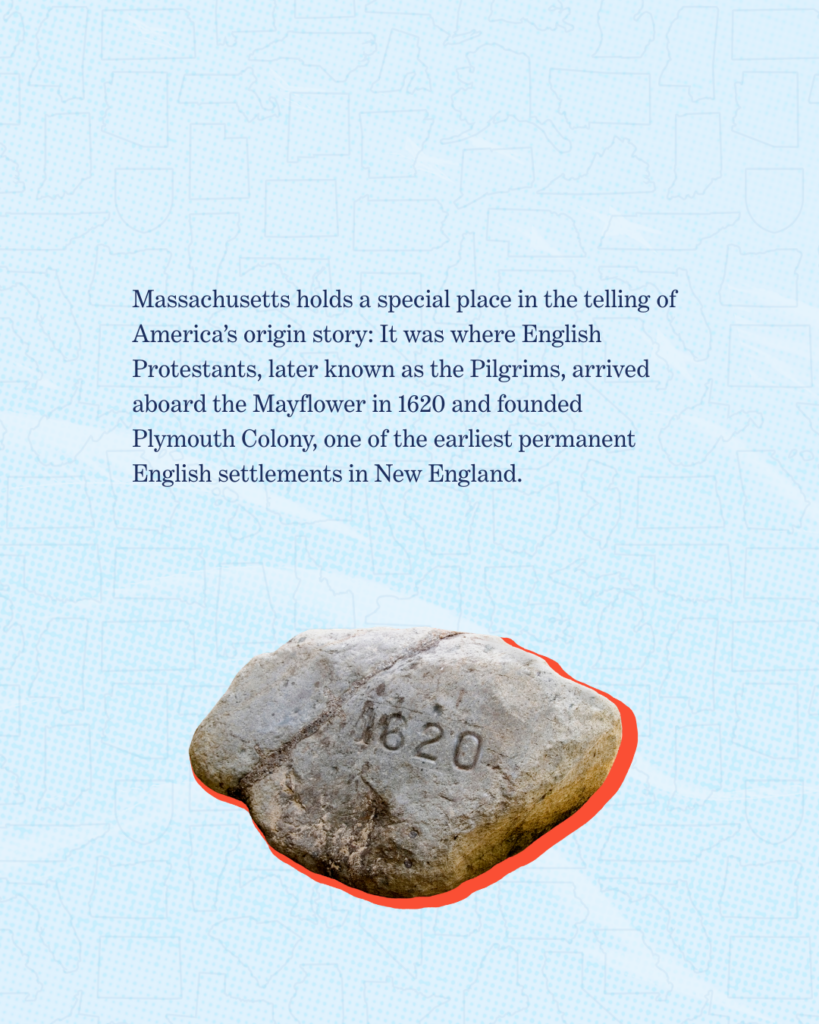
Massachusetts holds a special place in the telling of America’s origin story: It was where English Protestants, later known as the Pilgrims, arrived aboard the Mayflower in 1620 and founded Plymouth Colony, one of the earliest permanent English settlements in New England. The Pilgrims are widely credited with celebrating the 1621 harvest feast often referred to as the first Thanksgiving.
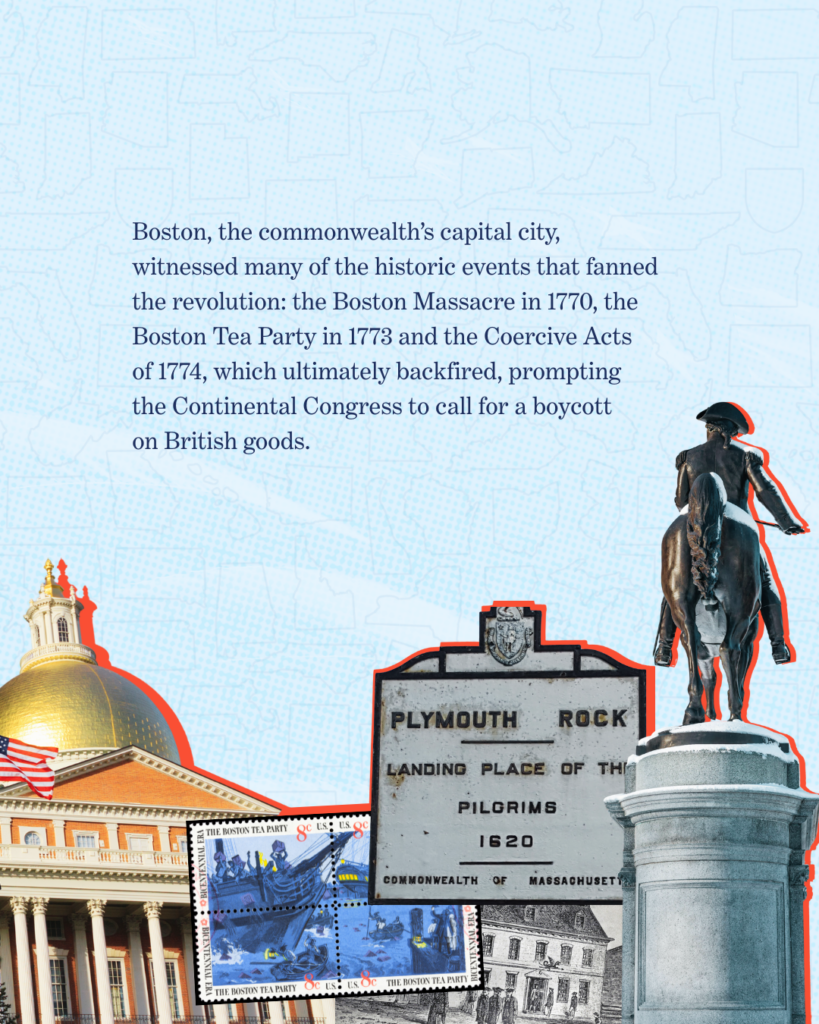
Boston, the commonwealth’s capital city, was where the seeds of American independence were first planted. Early attempts by Great Britain to tax the American colonies proved unpopular, spawning protests in Boston and giving rise to the notion of “no taxation without representation.” The city witnessed many of the historic events that fanned the revolution: the Boston Massacre in 1770, the Boston Tea Party in 1773 and the Coercive Acts of 1774, which ultimately backfired, prompting the Continental Congress to call for a boycott on British goods.
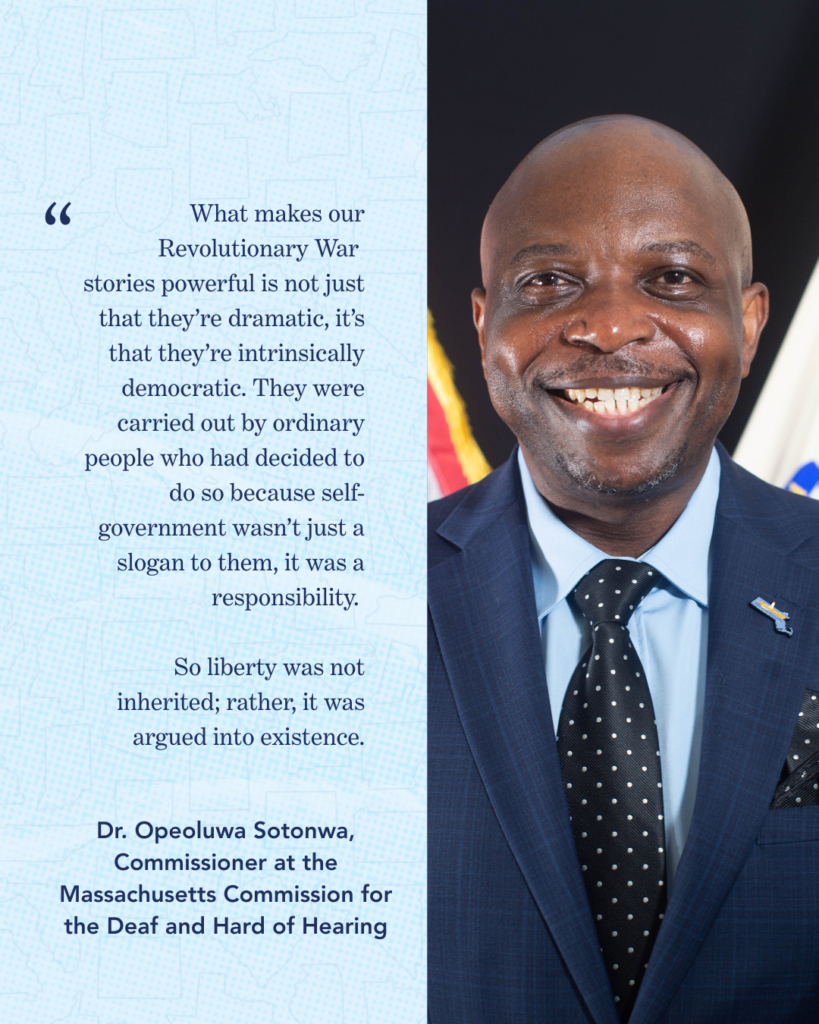
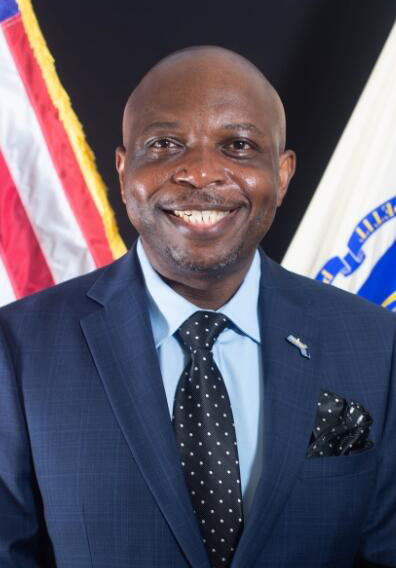
“Massachusetts is called ‘the cradle of liberty,’ and oftentimes it was less a cradle and more a forge — which is to say freedom was not gently rocked into existence, it was hammered into shape,” said Dr. Opeoluwa Sotonwa, commissioner at the Massachusetts Commission for the Deaf and Hard of Hearing (MCDHH) and a 2024 CSG Toll Fellow. “What makes our Revolutionary War stories powerful is not just that they’re dramatic, it’s that they’re intrinsically democratic. They were carried out by ordinary people who had decided to do so because self-government wasn’t just a slogan to them, it was a responsibility. So liberty was not inherited; rather, it was argued into existence.”
As reputations go, Massachusetts might be best known for its commitment to education. It has the highest percentage of residents with advanced degrees of any state in the nation. And it’s home to many of America’s first schools: Harvard University, founded in 1636, and Boston Latin School, the first public secondary school, established in 1635. Additionally, Helen Magil White, the first woman in America to earn a Ph.D., made history at Boston University in 1877.
“Massachusetts made an early, radical bet,” Sotonwa said. “An educated population is a free population. So public education here was not designed merely to produce scholars — it was designed to produce citizens. Education is our civic infrastructure, essential as roads and bridges, and perhaps even more so. Roads can move goods, but education can move generations. That’s why education here feels less like an industry and more like a moral commitment.”
The state also had its share of pioneers who made their mark on the world. James Naismith invented basketball at a YMCA in Springfield in 1891. Charles Goodyear invented the vulcanization process for rubber in 1839 (the Goodyear Tire & Rubber Company, however, wouldn’t be founded until nearly 40 years after his death). And Theodore Seuss Geisel, who wrote more than 50 children’s books under the pseudonym Dr. Seuss, hailed from Springfield as well.
“What do these people have in common?” Sotonwa asked. “They were all solving problems. Innovation is rarely accidental. Rather, it’s born from inquiry and from the friction of ideas colliding in classrooms, labs, hospitals and coffee shops. We debate intensely here in Massachusetts. And sometimes loudly. But that intellectual friction produces sparks.”
On the culinary side, Massachusetts might be best known for its signature franchise: Dunkin’ Donuts. In 1948, Bill Rosenberg opened a restaurant called Open Kettle in Quincy, serving premium coffee and donuts. Just two years later, he renamed the business Dunkin’ Donuts, launching what would become a national brand.
Massachusetts also spawned such franchises as Friendly’s (originally an ice cream shop in Springfield), Bertucci’s (brick oven pizza) and Boston Chicken (fast-casual rotisserie chicken meals). But the state’s proximity to the Atlantic Ocean also brings another benefit — some of the nation’s best seafood. “If you come to Massachusetts, you really have to have the clam chowder,” Sotonwa said. “Eating some chowder is just about mandatory. And it usually comes in a very small bowl and features a white creamy sauce. And if you order it, might I suggest that you be ready for seconds because it’s really great.”